
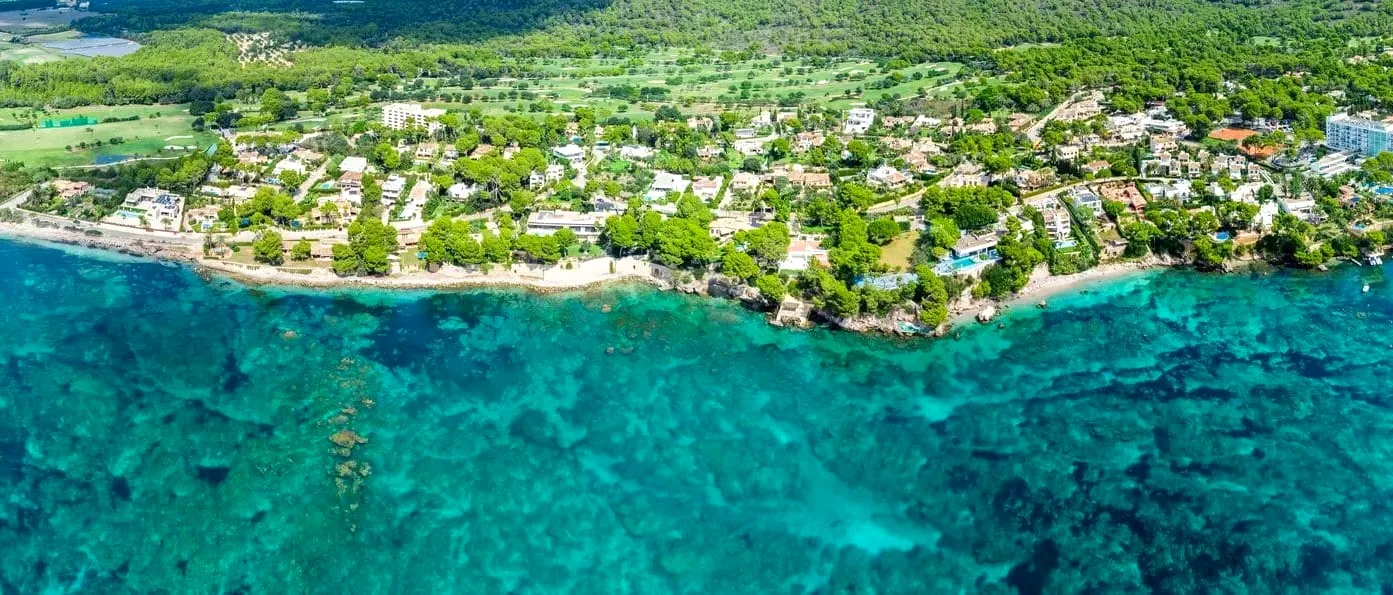
East Mallorca begins broadly around Manacor and the eastern coastline and continues through Porto Cristo, Cala Mendia, Sa Coma, Cala Millor, Son Servera, Costa dels Pins, Canyamel, Artà, Capdepera and Cala Ratjada. It contains working towns, quiet residential enclaves, large tourism centres, rural estates and remarkably undeveloped landscapes within the same region.
Maximum variety, but choose the exact location carefully.
Who chooses the East
The East works well for buyers who are relatively self-contained and willing to look beyond Mallorca’s best-known prime addresses. It can offer larger properties, countryside and coastal settings while still maintaining substantial year-round infrastructure around Manacor.
Artà suits a buyer seeking a smaller historic town and proximity to nature; Porto Cristo offers a port environment; Costa dels Pins and Canyamel can be considerably more private; Cala Millor and Cala Ratjada have a much stronger resort component.
Sport, nature and family life
Manacor gives the region a distinctive sporting asset through the Rafa Nadal Academy, whose facilities now include extensive tennis and padel infrastructure. The associated Rafa Nadal School also provides an international educational option in Manacor—an important practical distinction for families considering the eastern side of the island.
Farther north, the Península de Llevant Natural Park extends through Artà, Capdepera, Sant Llorenç and Santa Margalida, providing one of the strongest natural counterpoints to the developed resort coastline.
Connections and practicalities
Manacor is the practical hub of the East. The T3 railway links it directly with Palma through Sineu and Inca, and the town has its own public hospital, reducing dependence on Palma for many everyday requirements.
Allow approximately 35–45 minutes to the airport from Manacor, around 45–60 minutes from Porto Cristo or Cala Millor and approximately 55–70 minutes from Artà, Capdepera or Cala Ratjada. For somebody travelling every week, that difference should be considered seriously rather than dismissed as insignificant.
What to understand before buying
The East’s strength is also its weakness: the region changes character very quickly. Ten kilometres can take a buyer from a working year-round town to a predominantly seasonal resort, from open countryside to dense apartment development, or from an active coastal centre to near isolation.
The East therefore rewards precise property search more than broad area selection. For the right buyer it can provide an excellent balance of coast, space and independence; for somebody needing Palma every day, the geography can eventually become tiring.